Publication
2026 End-of-Year Plan Sponsor “To Do” List (Part 1) Health and Welfare
We are pleased to present our annual End-of-Year Plan Sponsor “To Do” Lists. This year, we present our “To Do” Lists in four separate SW Benefits Updates. Part 1 covers year-end health and welfare plan issues. Parts 2, 3, and 4 will cover executive compensation issues, qualified plan issues, and cost-of-living increases, but not necessarily in that order. We expect to publish the other Parts later this year. Each SW Benefits Update provides a checklist of items to consider before the end of 2026 or in early 2027. We hope these “To Do” Lists help focus your efforts heading into 2027.
Although we identify many action items to consider below, through the end of 2026 and in 2027, we expect employers will focus their compliance efforts on cost containment measures, plan design changes, lawsuit and enforcement trends, and continued compliance efforts.
Part 1 – Health and Welfare Plans “To Do” List
Subpart A – Consider Cost Containment Measures
Adjust Plan Design: Employers may not be able to keep absorbing rising health care costs. Some may need to shift more of those costs to participants through higher deductibles, copays, coinsurance, and employee premiums. Employers with high prescription drug costs may also need to reevaluate how they cover and manage use of GLP-1 drugs, their pharmacy benefit manager (“PBM”) contracting model (traditional, hybrid, or pass-through), and other ways of giving participants access to prescription drugs, such as direct-to-consumer models.
Monitor Third Parties: Under the Employee Retirement Income Security Act of 1974 (“ERISA”), the fiduciary duty of prudence includes an ongoing duty to monitor plan service providers, such as third-party administrators (“TPAs”), PBMs, brokers, and consultants. Plan sponsors should consider the following steps:
- Assess Fee Reasonableness: Review all direct and indirect service provider compensation and push back on fees that are unreasonable or above market benchmarks. For self-funded plans, shared savings fees are a common example. Under these arrangements, the TPA keeps a percentage (typically 10%–50%) of the difference between an out-of-network provider’s billed charges and the amount paid by the self-funded plan. These fees create perverse incentives: the TPA earns more when billed charges are inflated, its fee can exceed the cost of the care itself, and more disputes may be pushed into the No Surprises Act (“NSA”) independent dispute resolution (“IDR”) process, which can generate additional TPA fees and higher costs for the plan. Plan sponsors should determine whether their TPA charges shared savings fees and how much it earns from them each year. Because TPAs are increasingly unwilling to negotiate the shared savings percentage, plan sponsors may need to audit these claims to identify and challenge unreasonable fees.
- Request ERISA Section 408(b)(2) Compensation Disclosures: The Consolidated Appropriations Act, 2021 (“CAA”) amended ERISA Section 408(b)(2) to require “covered service providers” to group health plans to disclose to a responsible plan fiduciary the direct and indirect compensation they expect to receive in connection with their services. As originally enacted, the term covered persons who provide “brokerage services” or “consulting” to ERISA-covered group health plans and who reasonably expect to receive $1,000 or more in direct or indirect compensation. The Consolidated Appropriations Act, 2026 (“CAA 2026”), effective February 3, 2026, expanded the definition beyond brokers and consultants to include providers of other enumerated services, such as “third-party administration” and “pharmacy benefit management,” for all group health plans, including fully insured plans. If a covered service provider fails to make the required disclosures, the arrangement is not “reasonable” under ERISA Section 408(b)(2) and is therefore a prohibited transaction. Because many covered service providers still do not comply, either by providing no disclosure or an incomplete one, plan fiduciaries should request these disclosures proactively.
- Prepare to Leverage New PBM Transparency Rules: Two recent federal actions give plan sponsors new tools to manage prescription drug costs.
- CAA 2026 – In addition to bringing PBMs within the ERISA Section 408(b)(2) disclosure requirements (described above), CAA 2026 requires PBMs, effective for plan years beginning on or after August 3, 2028 (January 1, 2029, for calendar year plans), to pass through 100% of manufacturer rebates, fees, alternative discounts, and other remuneration to ERISA plans and to provide semiannual drug spending reports to large plans.
- Improving Transparency Into PBM Fee Disclosure Final Regulations – On November 2, 2026, the Department of Labor (“DOL”) published final regulations under ERISA Section 408(b)(2) requiring PBMs and their affiliates that serve large self-funded group health plans (i.e., employers with an average of at least 100 employees and plans with an average of at least 100 participants) to disclose their direct, indirect, and other compensation in dollar amounts before a PBM contract is entered into or renewed and to update those disclosures semiannually (or quarterly upon request). The final rule is effective January 4, 2027, and applies to plan years beginning on or after July 1, 2027. Because a PBM’s failure to provide timely disclosures may cause the arrangement to be a prohibited transaction, plan fiduciaries should be prepared to request missing disclosures and, if necessary, take corrective action. DOL is still considering a standardized disclosure template and a fiduciary safe harbor. For more information, see our Legal Alert, “Pharmacy Benefit Managers Now on the Hook to Provide Greater Transparency on Fee Structures.”
- Leverage the NSA: The NSA and implementing regulations do not completely eliminate surprise billing, but they provide relief from some of the more common scenarios in which an individual may experience unexpected medical costs, including: (1) emergency services; (2) non-emergency services performed by nonparticipating providers at participating health care facilities; and (3) air ambulance services. For more information about the NSA and its impact on employer-sponsored group health plans, see our SW Benefits Update, “Not All Surprises Are Good – Phase I of the Surprise Billing Rules.” Although the law has limited balance billing for participants, its IDR process has had a significant financial impact on group health plans because there are far more disputes than anyone expected, providers almost always win, and awards are typically above market rates. Because group health plans rely on their TPA to comply with this law, it is important for plans to generally understand the following:
- What is the impact of IDR on the plan? Plan sponsors may want to consider asking their TPA annually: (1) how many claims have gone to IDR; (2) of these claims, how many were decided against the plan (i.e., in favor of the providers) and what is the amount of each claim; and (3) of these claims, how many were default decisions (i.e., because the TPA did not submit timely information). With this data, the group health plan can then potentially push back on the TPA and consider whether contractual performance guarantees should be incorporated into the TPA’s administrative services agreement.
- What is the TPA charging for IDR? As of June 11, 2026, the administrative fee for the IDR process has been reduced from $115 to $15 per party per dispute. Because most TPAs pass this fee along to group health plans, group health plans should ensure that TPAs are passing along the lesser amount. In addition, group health plans should understand whether their TPA assesses a “shared savings fee” for IDR disputes, or even claims that ultimately go to IDR. If fees are unreasonable, plans should consider pushing back.
- Is the TPA prepared to comply with new IDR rules? On May 28, 2026, the federal government issued final rules and a fact sheet that change the IDR process. These changes affect how a group health plan communicates with out-of-network providers, participates in payment negotiations, and resolves billing disputes. Plan sponsors should work with their TPA to confirm that existing processes meet the new standards. If a plan sponsor fails to comply with procedural requirements, the arbitrator may rule in favor of the provider by default, unnecessarily increasing plan costs. This problem is further exacerbated by the IDR process’s “baseball-style” arbitration, in which an independent arbitrator selects either the plan’s or the provider’s proposed payment amount. As noted above, to mitigate this risk, plan sponsors can work with their TPAs and include protective provisions in their TPA services agreement. For more information, see our SW Benefits Blog, “What Plan Sponsors Need to Know About the Federal Independent Dispute Resolution (“IDR”) Operations Final Rules – Five Takeaways.”
Be Skeptical of Aggressive Cost-Saving Schemes and Abusive Billing Practices: As health care costs rise, plan sponsors are being targeted from two directions: (1) vendors who promote arrangements that promise dramatic savings; and (2) out-of-network providers who recruit plan participants for elective procedures and then submit grossly inflated bills designed to exploit gaps in plan terms. Plan sponsors should vet promoters carefully, understand exactly how the claimed savings are generated and how the vendor is paid, and get independent legal advice before adopting any program. They should also work with their TPAs to scrutinize unusually large out-of-network claims before paying them. Common examples include the following:
- Alternative Funding Programs: Vendors are increasingly marketing alternative funding and claimant-steering programs to plan sponsors. These programs work by moving a plan’s most expensive claims onto someone else: drug manufacturers, charities, government programs, or the Affordable Care Act (“ACA”) individual market. The savings come from making high-cost participants look uninsured, or getting them to actually become uninsured, for a particular benefit. Vendors typically charge steep fees for these programs, often a large percentage of the claimed “savings” or ongoing per-member fees, which continue for as long as the program is in place and can erode much of the savings the plan actually realizes. These programs generally violate ERISA, Health Insurance Portability and Accountability Act (“HIPAA”) nondiscrimination rules, and Medicare Secondary Payer rules, and may trigger excise taxes under Internal Revenue Code (“Code”) Section 4980D.
- “Double-Dipping” Wellness Programs: Vendors are increasingly marketing “double-dipping” wellness and fixed indemnity programs to plan sponsors as a way to cut payroll taxes. These programs work by having employees pay for a wellness or fixed indemnity policy with large pre-tax salary reductions through a cafeteria plan and then returning roughly the same amount to them as supposedly tax-free “benefits” for minor activities like watching a health video or calling a nurse line. The savings come from treating the same dollars as tax-free going in and coming out, which reduces both the employer’s and the employees’ FICA taxes. Vendors typically charge significant ongoing fees for these programs, often a per-employee monthly fee or a large share of the employer’s claimed tax savings, which continue for as long as the program is in place even though the tax treatment those fees are based on does not hold up. The Internal Revenue Service (“IRS”) has repeatedly concluded that these payments are taxable wages because they don’t reimburse actual medical expenses. Employers that adopt these programs face liability for unpaid income tax withholding, FICA, and FUTA, plus interest and penalties, and may also have cafeteria plan qualification and ERISA fiduciary problems.
- Egregious Pricing from Out-of-Network Doctors: Out-of-network providers are increasingly targeting self-funded plan participants for elective, high-cost procedures, such as lipedema surgery and spine and pain treatments, and billing charges that can reach into the millions of dollars for a single course of treatment. These schemes work by recruiting participants directly, often with promises that they will owe little or nothing, and then billing far above market rates. Because the patient knowingly schedules the care with an out-of-network provider, the NSA generally does not protect against these bills. The providers typically waive the participant’s cost sharing, take an assignment of plan benefits, and use the threat of balance billing or ERISA litigation to pressure the plan into paying. Plans that pay based on billed charges or “usual and customary” amounts, or that do not clearly define how much they pay out-of-network, may be obligated by their own terms to pay a large share of these inflated bills. As noted above, TPA shared savings fees add to the cost because the TPA earns more as the billed charge goes up. Plan sponsors that do not address these claims risk significant overpayments, higher stop-loss premiums or denied stop-loss claims, and ERISA fiduciary exposure for the imprudent use of plan assets.
Subpart B – Consider Plan Design Changes
Evaluate Contributions to Trump Accounts: The One Big Beautiful Bill Act (“OBBBA”) created a tax-advantaged vehicle called a “Trump Account,” which is intended to encourage children to start saving and investing at an early age. Although the specific mechanics remain in development, employers may contribute to the Trump Accounts held by qualifying employees and/or their dependents. Up to $2,500 of an employer’s contribution may be excluded from an employee’s gross income if it is made pursuant to a written program. The Department of Treasury issued proposed regulations on how to structure and fund accounts, but several structural questions are still open. For more information, see our SW Benefits Blogs, “The (Final) Regs Are Yet to Come: What Employers Should Know About Contributions to Trump Accounts” and “Trump Accounts: Four Things Employers Should Know.”
Consider Increased Dependent Care Assistance Program (“DCAP”) Limits: Effective January 1, 2026, OBBBA increased the maximum amount that can be contributed to DCAPs from $5,000 to $7,500 and from $2,500 to $3,750 for married couples filing separately. Employers contemplating the increased limit should confirm that the increase would not cause the DCAP to fail applicable nondiscrimination testing under Code Section 129 and may consider relying on recently issued proposed nondiscrimination rules. Generally, DCAP nondiscrimination requirements include passing the following tests: (1) 55% average benefits test; (2) contributions and benefits test; (3) eligibility test; and (4) 25% owner concentration test. Notably, the proposed rules consider only employees who actually receive DCAP benefits when applying the 55% average benefits test and add a numerical safe harbor and a facts and circumstances test for the eligibility test, which often makes the test easier to pass. Once they confirm the increase will not cause a testing failure, employers should coordinate their change with their DCAP administrator, amend their cafeteria plan document before the beginning of the 2027 plan year, and notify employees of the change during open enrollment.
Consider Offering Fertility Benefits as an Excepted Benefit: In response to Executive Order 14216: Expanding Access to In Vitro Fertilization, DOL, the Department of Health and Human Services (“HHS”), and the Department of Treasury (collectively, the “Departments”) have clarified in ACA FAQs Part 72 that employers can offer fertility benefits as an excepted benefit in three ways.
- Independent Noncoordinated Excepted Benefit: First, an employer may offer fertility benefits as an independent, noncoordinated excepted benefit if the benefits: (1) are provided under a separate policy, certificate, or contract of insurance (i.e., the benefits may not be self-funded); (2) are not coordinated with any group health plan from the same plan sponsor; and (3) are paid without regard to whether other health coverage applies. For example, an employer could offer a specified disease or illness policy that covers infertility benefits.
- Excepted Benefit Health Reimbursement Arrangement (“HRA”): Second, an employer may offer fertility benefits through an excepted benefit HRA if: (1) the HRA is not an integral part of the plan (e.g., a major medical plan is separately offered); (2) the HRA’s benefits are limited in amount (e.g., do not exceed $2,250 for plan years beginning in 2027); (3) the HRA does not reimburse premiums for individual health insurance coverage, group health plan coverage (other than continuation coverage under the Consolidated Omnibus Budget Reconciliation Act (“COBRA”)), or Medicare, except premiums for coverage consisting solely of excepted benefits; and (4) the HRA is made available on the same terms to all similarly situated individuals, regardless of any health factor. For example, an excepted benefit HRA could reimburse employees’ out-of-pocket fertility expenses.
- Limited Excepted Benefit Employee Assistance Program (“EAP”): Third, an employer may offer fertility coaching and navigation services through an EAP. For more information on when an EAP qualifies as an excepted benefit, see our SW Benefits Blog, “What is Telemedicine? A Cool Benefit or a Hot Mess?”
- Proposed Fertility Excepted Benefit (Not Yet Effective): On May 13, 2026, the Departments issued proposed regulations that, if finalized, would create a new category of limited excepted benefits for fertility benefits, effective for plan years beginning on or after January 1, 2027. The proposed category would supplement, not replace, the three existing excepted benefit designs summarized above. Under the proposed regulations, fertility benefits would qualify as limited excepted benefits only if: (1) substantially all of the benefits are for the diagnosis, mitigation, or treatment of infertility or related reproductive health conditions and are furnished by licensed medical professionals; (2) total lifetime benefits per participant, together with the participant’s eligible beneficiaries, do not exceed $120,000, indexed for medical inflation; (3) the benefits are provided under a separate policy, certificate, or contract of insurance or are otherwise not an integral part of a group health plan; and (4) participants receive a separate notice describing the benefits and their limitations. Employers may not rely on the proposed regulations until they are finalized and should evaluate any final rule before designing a fertility benefit.
Permanent Telehealth Relief: OBBBA permanently allows high-deductible health plans (“HDHPs”) to provide telehealth and other remote care services on a pre-deductible basis, without impacting an individual’s ability to contribute to a health savings account (“HSA”). This optional relief, which was initially enacted on a temporary basis, is now permanently effective retroactive to January 1, 2025. In Notice 2026-05, IRS provided additional guidance, indicating that services on Medicare’s list of telehealth services will be treated as telehealth and other remote care services and clarifying that the relief does not extend to in-person services, medical equipment, or drugs furnished in connection with a telehealth visit. Employers should clearly communicate whether their HDHPs provide telehealth and other remote care services on a pre-deductible basis and, to the extent that an employer offers such services on a pre-deductible basis, confirm that their plan limits the change to qualifying services. This may require a plan amendment, revised summary plan description (“SPD”), or summary of material modifications (“SMM”).
Permanent Student Loan Repayment Benefit: Under the Coronavirus Aid, Relief, and Economic Security Act (“CARES Act”), employers are permitted to contribute up to $5,250 per year (after 2026, adjusted for inflation) against student loan repayments. These payments can be excluded from taxable income and are not subject to payroll tax. The student loan repayment benefit was set to expire after December 31, 2025, but Congress eliminated the provision’s sunset date and made the benefit permanent under OBBBA. To take advantage of this benefit, employers must adopt a written policy (or amend an existing policy) and otherwise comply with the formal requirements of Code Section 127, which governs qualified educational assistance programs. To encourage adoption and compliance, IRS published a model Educational Assistance Program that includes language on student loan repayment.
Direct Primary Care Service Arrangements (“DPCS Arrangements”) Relief: Generally, individuals cannot have health coverage other than HDHP coverage in order to make or receive HSA contributions, subject to limited exceptions. These exceptions include permitted insurance (e.g., insurance for a specified disease or illness and hospital indemnity insurance), permitted coverage (e.g., coverage for accidents, disability, dental care, vision care, long-term care, or telehealth and other remote care), and pursuant to OBBBA, effective January 1, 2026, DPCS Arrangements. Very generally, a DPCS Arrangement is one in which an individual receives primary care services from primary care practitioners for a fixed periodic fee. Importantly, primary care services cannot include procedures that require general anesthesia, prescription drugs (other than vaccines), or laboratory services not typically administered in an ambulatory primary care setting, and the fixed periodic fee cannot exceed $150 per month (or $300 per month if the arrangement covers more than one individual) indexed for inflation.
Subpart C – Consider Lawsuit and Enforcement Trends
Tobacco Surcharge Programs: If an employer requires tobacco users to pay a higher medical plan premium than non-tobacco users, that is a health-contingent wellness program that must satisfy a five-part test including: (1) eligible individuals must have an annual opportunity to qualify for the full reward; (2) the total reward may not exceed 50% of the total cost of coverage; (3) the program must be reasonably designed and provide a reasonable alternative standard to all tobacco-users; (4) the program must be available to all similarly situated individuals; and (5) the employer must disclose the reasonable alternative standard in all plan materials that describe the tobacco surcharge.
- Generally, tobacco surcharge lawsuits have targeted employers alleging the following: (1) the employer failed to offer a reasonable alternative standard (e.g., a smoking cessation program); (2) the employer offered a reasonable alternative standard but failed to provide the full reward (e.g., the employer reduced premiums on a prospective basis after the individual completed the smoking cessation program mid-year); (3) the employer did not sufficiently disclose the reasonable alternative in all plan materials that described the tobacco surcharge (e.g., the notice was missing, or the notice was incomplete or vague); (4) the employer’s reasonable alternative standard notice failed to state that the program would accommodate the recommendations of an individual’s personal physician; and (5) the employer misused surcharge money as a plan fiduciary.
- Notwithstanding the above, on August 26, 2026, the Departments issued ACA FAQs Part 74 indicating that they would not take enforcement action against a plan that removes the surcharge only going forward (not retroactively) once a participant completes the alternative. This guidance does not bind courts. Several courts also dismissed these suits, holding that retroactive refunds and a personal-physician statement are not required, but other courts have let similar claims proceed. Employers should confirm that all plan materials clearly describe the alternative and how the surcharge is removed.
Increased Fiduciary Litigation Risk: The concept of fiduciary duties under ERISA is not new. However, until recently, the focus has been on retirement plans. There are four main ERISA fiduciary duties: (1) the duty to act solely in the interest of plan participants and beneficiaries (Duty of Loyalty/Exclusive Benefit Rule); (2) the duty to carry out responsibilities prudently (Duty of Prudence); (3) the duty to diversify assets of the plan (Duty of Diversification); and (4) the duty to comply with the provisions of the plan (Duty to Follow Plan Documents). The CAA, the CAA 2026, and the Transparency in Coverage Rules give group health plans access to an unprecedented amount of new information, which serves as a double-edged sword. That information may be used by plans to reduce health plan costs and by plaintiffs’ lawyers to sue plans and other parties (e.g., insurers, TPAs, and PBMs).
- Lawsuit Trends: There have been various lawsuits where plaintiffs allege that the employer and its PBM mismanaged the plan’s prescription drug benefits causing millions of dollars of harm to employees and their dependents in the form of higher payments for prescription drugs, premiums, deductibles, coinsurance, copays, lower wages, and limited wage growth. Although health plan participants have generally not been successful in these lawsuits, the litigation is not over. Because we expect plaintiffs’ lawyers will refine their arguments and continue their efforts, plan fiduciaries should understand what their PBM contract entails and undertake an analysis of whether the fees the plan pays are “reasonable.” In our SW Benefits Blog, “Perplexed and the Fiduciary Committee – PBM Edition,” we identify various factors a plan fiduciary may want to use when engaging in the process of selecting and monitoring a PBM.
- Fiduciary Governance Best Practices: Ultimately, the best defense against a breach of fiduciary duty claim is for a plan to implement prudent processes (e.g., when selecting and monitoring service providers, including obtaining and evaluating required service provider compensation disclosures) and to formally establish a welfare plan fiduciary committee to oversee group health plan administration. If a plan does not identify a fiduciary committee, the board of directors of the employer is the fiduciary. However, because the board of directors does not manage day-to-day benefit plans, in the event of a lawsuit it could be hard to demonstrate its fulfillment of ERISA’s fiduciary duties. See our fiduciary checklist designed to help health and welfare plan fiduciaries comply with their ERISA fiduciary responsibilities.
Be Wary of Employee Retention Credit Pitfalls: The CARES Act provided for an employee retention tax credit (“ERTC”) designed to encourage employers to retain workers during the pandemic. The requirements of the ERTC program are complex, and IRS has identified many employers that claimed credits without meeting the applicable eligibility criteria. Accordingly, enforcement actions are on the rise and pending applications remain under significant scrutiny. Recognizing the widespread errors in the ERTC program, IRS established a withdrawal program for certain credits in process. Given IRS’s sustained focus on ERTC compliance, employers might consider whether their filings were properly made and whether affirmative corrective action is warranted.
Confirm Employees’ Life Insurance Coverage if Deducting Premiums: Many employers that sponsor ERISA life insurance plans use self-billing arrangements to remit employees’ premiums to their life insurance providers. At times, this causes employers to deduct life insurance premiums from their employees’ paychecks prior to the insurers’ receipt of the proof of good health, or evidence of insurability, necessary to issue the life insurance policy. DOL has been investigating life insurance companies’ practice of accepting employees’ premiums without verifying their insurability, which leads employees and their beneficiaries to believe that they have life insurance coverage, and subsequently denying claims because the insurer failed to receive the employees’ evidence of insurability. DOL has reached settlements with multiple life insurance companies that prevent the insurers from denying benefit claims under ERISA life insurance plans solely for lack of evidence of insurability when an employee has paid premiums for 90 days or more. Employers should consider establishing a process pursuant to which they work with their life insurance providers to ensure that the employees for whom they are remitting life insurance premiums have coverage under their life insurance plan.
Identify and Correct COBRA Notice Failures: If applicable, COBRA requires employers to distribute general and election notices. Employers that fail to timely comply with these notice rules are subject to significant excise taxes and must self-report to IRS. An employer may avoid the excise tax penalty and the related filing requirement if the failure was due to reasonable cause and the failure is corrected within 30 days of the date that it was discovered or should have been discovered using reasonable diligence. Employers should consider regularly confirming they are complying with the COBRA notice requirements and, if necessary, correct any failures immediately upon discovery. This vigilance is especially important given the rise of litigation alleging deficient COBRA notices.
Consider Duty to Monitor TPAs and Insurers for Cross-Plan Offsetting Practices: The U.S. District Court for the District of New Jersey held in Lutz Surgical Partners v. Aetna that cross-plan offsetting violates ERISA’s fiduciary rules and results in a prohibited transaction. The U.S. Court of Appeals for the Eighth Circuit also called the practice into question in Peterson v. UnitedHealth Group. Litigation over cross-plan offsetting increased in 2026, with plan sponsors themselves increasingly bringing the claims. Accordingly, employers should determine whether their plans permit cross-plan offsetting. If plan terms do not permit cross-plan offsetting, employers should confirm that their TPA or insurer is not using cross-plan offsetting with respect to their plans. Employers should also consider asking for claims-level data and audit rights in their administrative services agreements so they can verify this. If plan terms permit cross-plan offsetting, employers should weigh the risks of allowing their TPAs or insurers to use cross-plan offsetting to recoup overpayments. Allowing it may expose employers, as plan fiduciaries, to potential liability for ERISA violations.
Subpart D – Continue with Compliance Efforts
Evaluate the Use of Artificial Intelligence (“AI”) in Plan Administration: Health and welfare plan service providers are increasingly using AI tools for claims adjudication, prior authorization and utilization review, fraud detection, participant communications and navigation, and benefits enrollment. Plan sponsors and their human resources teams are also adopting AI tools that may access plan data. Although no federal law specifically governs the use of AI by ERISA plans, existing rules apply. Choosing and monitoring an AI-enabled service provider is a fiduciary act subject to ERISA’s duty of prudence. AI-driven claims and medical necessity decisions must still comply with ERISA’s claims and appeals procedures, the plan’s terms, and mental health parity rules for nonquantitative treatment limitations (“NQTLs”). AI tools that use or disclose PHI raise HIPAA privacy and security issues. In addition, plaintiffs have filed class actions alleging that insurers used algorithms to deny claims improperly, and a growing number of states regulate the use of AI in utilization review.
- Service Provider Action Items: When selecting, monitoring, and negotiating with TPAs, PBMs, and other vendors, plan sponsors should ask: how the vendor uses AI, especially in claims and prior authorization decisions; whether a qualified human reviews adverse benefit determinations; how the vendor tests its tools for accuracy, bias, and Mental Health Parity and Addiction Equity Act (“MHPAEA”) compliance; and whether PHI is used to train AI models. Plan sponsors should also consider adding provisions to administrative services agreements and business associate agreements that require disclosure of AI use, restrict the use of plan data, and provide audit rights and indemnification.
Employee Benefits Security Administration (“EBSA”) Cybersecurity Guidance: In 2021, EBSA issued cybersecurity guidance to help plan sponsors, fiduciaries, service providers, and participants in employee benefit plans safeguard plan data, personal information, and plan assets. It included: (1) Tips for Hiring a Service Provider; (2) Cybersecurity Program Best Practices; and (3) Online Security Tips. In Compliance Assistance Release No. 2024-01, EBSA clarified the guidance applies to all types of ERISA plans, including health and welfare plans and all employee pension benefit plans. Even if health plans are HIPAA compliant, plan sponsors and fiduciaries must take additional steps to comply because the scope of EBSA’s cybersecurity guidance is broader than HIPAA. In January 2026, EBSA named cybersecurity one of its top national enforcement projects for fiscal year 2026.
- Internal Action Items: Plan sponsors and fiduciaries should review their internal cybersecurity policies, update them as needed, and educate participants and beneficiaries about online security, for example, by distributing EBSA’s Online Security Tips. Given EBSA’s enforcement focus, plan sponsors and fiduciaries should also document their cybersecurity oversight process. That includes periodic risk assessments, service provider reviews, and committee minutes reflecting those reviews, so they can show a prudent process if EBSA opens an investigation.
- Service Provider Action Items: Plan sponsors and fiduciaries should evaluate existing agreements with all plan service providers and have discussions with them to confirm that they have a formal, well-documented cybersecurity program. DOL suggests that service provider contracts include provisions that: (1) require the service provider’s ongoing compliance with cybersecurity and information security standards; (2) require the service provider to annually obtain a third-party audit to determine compliance with information security policies and procedures; (3) address the use and sharing of information and confidentiality; (4) include notification requirements for cybersecurity breaches; (5) specify the service provider’s obligations to comply with record retention and destruction, privacy and information security laws; and (6) require insurance coverage that covers cybersecurity breaches and incidents involving the plan (e.g., professional liability and errors and omissions liability insurance, cyber liability and privacy breach insurance, and/or fidelity bond/blanket crime coverage).
Comply with Mental Health Parity Requirements: In general, the mental health parity rules require group health plans to ensure that financial requirements (e.g., copays, deductibles, and coinsurance), quantitative treatment limitations (e.g., visit limits and day limits), and NQTLs (e.g., prior authorization requirements, step therapy, and standards related to network composition) applicable to mental health or substance use disorder (“MH/SUD”) benefits are no more restrictive than the predominant requirements or limitations that apply to substantially all medical/surgical (“M/S”) benefits.
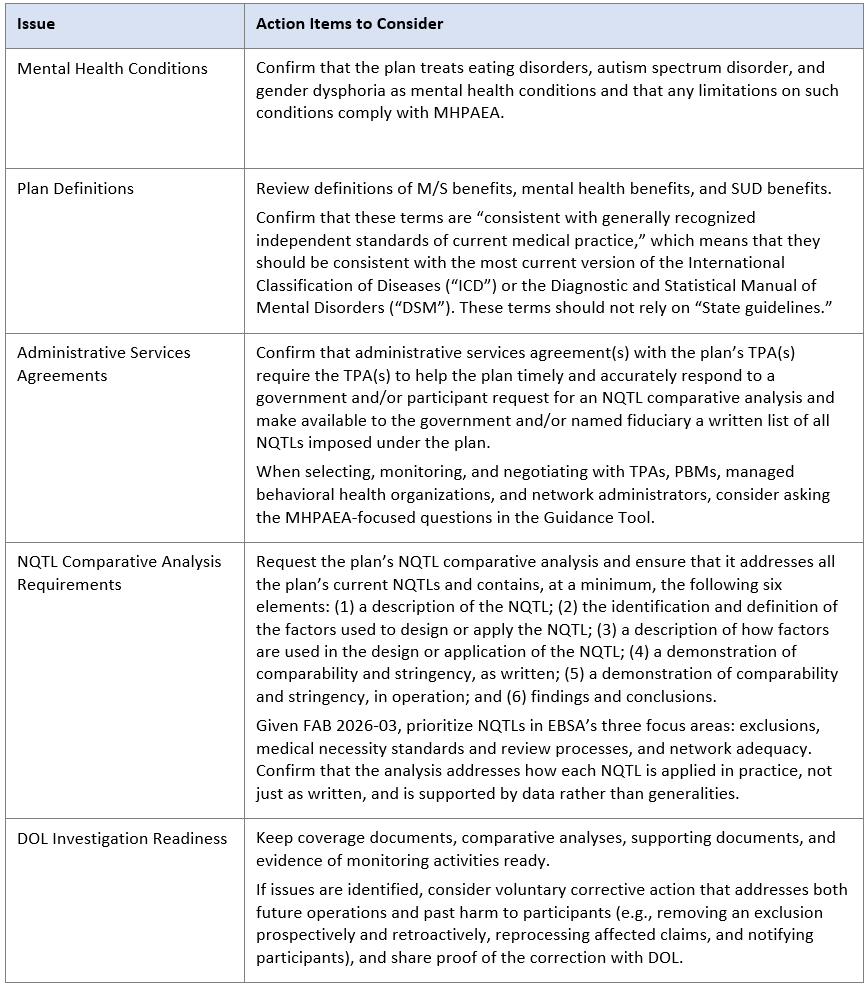
- Mental Health NQTL Comparative Analysis: Effective February 10, 2021, the CAA required group health plans that offer M/S benefits and MH/SUD benefits and impose NQTLs on the MH/SUD benefits to perform and document a comparative analysis of the design and application of the NQTLs. It also required group health plans to make the analysis available upon request to applicable state or federal authorities, participants, beneficiaries, or enrollees. On January 15, 2026, EBSA identified addressing barriers to MH/SUD benefits as a national enforcement priority for fiscal year 2026. On September 8, 2026, EBSA issued Field Assistance Bulletin No. 2026-03 (“FAB 2026-03”) and an accompanying enforcement guidance tool (the “Guidance Tool”) setting out a streamlined framework for NQTL compliance. Accordingly, employers that have not prepared this analysis may want to refer to the Guidance Tool, DOL’s MHPAEA Self-Compliance Tool and 2025 MHPAEA Report to Congress and coordinate with their TPAs and PBMs to do so as soon as possible. Employers will have only 10 business days to produce the analysis if requested by DOL and 30 days to respond to an ERISA request for documents from a plan participant. Notably, this requirement remains in place despite: (1) the lawsuit filed by the ERISA Industry Committee (“ERIC”) asking the court to hold various key provisions of the final rules as invalid; (2) the D.C. Circuit granting the Departments’ request for abeyance; and (3) the May 15, 2025, statement that the Departments will not enforce the 2024 final rule or otherwise pursue enforcement actions based on a failure to comply that occurs prior to the final decision in the ERIC litigation, plus an additional 18 months. Importantly, the nonenforcement relief applies only to those portions of the 2024 final rule that are new in relation to the 2013 final rule.
Below are some plan design and plan administration issues employers may want to consider, including the red flags and best practices identified in the Guidance Tool:
Be Proactive with HIPAA Privacy and Security Compliance: Similar to plan document maintenance, employers should continually review their HIPAA practices to keep up with new guidance and evolving risks. This year, employers may want to focus on the following:
- Update HIPAA Notice of Privacy Practices: Effective February 16, 2026, a group health plan must have updated its Notice of Privacy Practices to address confidentiality of substance use disorder patient records as required under the CARES Act. To help with compliance, HHS issued updated model notices.
- Ensure Compliance with the HIPAA Security Rule: Among other things, the HIPAA Security Rule requires covered entities to: (1) conduct an accurate and thorough risk analysis to determine the potential risks and vulnerabilities to the confidentiality, integrity, and availability of their electronic PHI (“ePHI”); (2) implement a risk management plan to address and mitigate security risks and vulnerabilities identified in their risk analysis; (3) review and develop, maintain, and revise, as necessary, their written policies and procedures to comply with the HIPAA Rules; (4) train their workforce on their HIPAA policies and procedures; and (5) review vendor relationships to ensure that business associate agreements are in place.
- Group health plans may want to refer to OCR’s recently updated Security Risk Assessment Tool to help them conduct a security risk assessment, in addition to OCR’s educational video, Cyber Awareness Newsletters, and the National Institute of Standards and Technology’s revised Cybersecurity Resource Guide and supplemental resources when developing compliance strategies to safeguard ePHI.
- Take Steps to Limit Liability Under HIPAA Security: In addition to minimizing the increased risk of cyberattacks, group health plans should maintain security practices to minimize potential liability. Pub. L. 116-321 amended the Health Information Technology for Economic and Clinical Health Act to require HHS to consider whether a covered entity or business associate has had recognized security practices in place for at least 12 months when determining fines, audits, and other remedies related to HIPAA security violations.
Continue to Implement Changes under the CAA: On December 27, 2020, the CAA was signed into law. The CAA includes numerous provisions that impact employer-sponsored group health plans, some of which are discussed above. Since its enactment, the Departments have been issuing regulations and guidance addressing CAA requirements. To the extent the Departments have not yet issued regulations or guidance, plans must implement the CAA’s requirements using a good faith, reasonable interpretation of the statute. Accordingly, employers should continually evaluate their CAA compliance obligations. See our CAA chart for more information regarding the principal requirements under the CAA that apply to employer-sponsored group health plans.
Continue to Comply with Transparency in Coverage Rules: In November 2020, the Departments issued Transparency in Coverage Final Rules. On October 6, 2026, the Departments issued updated Transparency in Coverage Final Rules, which take effect December 7, 2026. These “New Transparency Rules” implement Executive Order 14221: Making America Healthy Again by Empowering Patients With Clear, Accurate, and Actionable Healthcare Pricing Information and are intended to make public pricing disclosures more standardized, accurate, and accessible. The Transparency in Coverage requirements are extensive. Plan sponsors should work with their TPAs and issuers now to confirm compliance with the current rules and to plan for the 2027 and 2028 changes, including:
- Cost-sharing tool: Disclose to participants, beneficiaries, or enrollees, through an internet self-service tool, cost-sharing information for a covered item or service from a particular provider or providers. The information must also be available on paper upon request. This applied for plan years beginning on or after January 1, 2023, for 500 items and services and for plan years beginning on or after January 1, 2024, for all covered items and services. For plan years beginning on or after January 1, 2027, the cost-sharing information available through the online tool and on paper must also be available by phone. The phone number is the customer-assistance number on the participant’s ID card. Plans may limit phone responses to no fewer than 20 providers per day, but must tell the caller about the limit.
- Machine-readable files: Disclose pricing information to the public through three machine-readable files: (1) the “In-Network File,” showing payment rates negotiated between plans or issuers and providers for all covered items and services; (2) the “Out-of-Network File,” showing allowed amounts and billed charges for covered items or services from out-of-network providers; and (3) the “Prescription Drug File,” showing pricing information for prescription drugs. The New Transparency Rules provide significant updates to the machine-readable files and generally apply beginning March 6, 2027, with certain provisions applying beginning September 6, 2027. Until those dates, plans must continue to comply with the current rules.
- New utilization file: Starting July 1, 2028, plans must post a new annual utilization file for each In-Network File.
- Findability and accuracy: Plans must post a .txt file in the root folder of their website with the file URLs and a monitored contact email address. They must also add a footer link labeled “Price Transparency” or “Transparency in Coverage” to their website’s home page (and to any other page with a footer). Finally, they must attest to the accuracy and completeness of their files. The attestation requirement applies beginning March 6, 2027. The .txt file and footer requirements apply beginning September 6, 2027, and the .txt file must be posted on the first day of the following calendar quarter, which is October 1, 2027. After that, the .txt file must be updated within seven calendar days of any change.
- NSA price comparison: Plans that meet the cost-sharing disclosure requirements will also satisfy the price comparison guidance and tool requirements of the NSA. This includes grandfathered plans, which are otherwise not subject to the rules.
Consider Preventive Care Updates: Under Code Section 223, an HDHP may cover preventive care before the deductible is satisfied, including: (1) care within the IRS safe harbor described in IRS Notice 2004-23, such as periodic health evaluations (e.g., annual physicals), routine prenatal and well-child care, child and adult immunizations, tobacco cessation and obesity weight-loss programs, and specified screening services; (2) care that is incidental to preventive care or treats certain chronic conditions; (3) preventive services required under ACA; and (4) certain insulin products described in Code Section 223. Separately, ACA requires non-grandfathered group health plans to cover, without cost sharing: (1) evidence-based items or services with an A or B rating in the current recommendations of the United States Preventive Services Task Force (“USPSTF”); (2) immunizations for routine use in children, adolescents, or adults that are recommended by the Advisory Committee on Immunization Practices (“ACIP”) and in effect; (3) evidence-informed preventive care and screenings for infants, children, and adolescents provided for in comprehensive guidelines supported by the Health Resources and Services Administration (“HRSA”); and (4) additional evidence-informed preventive care and screenings for women provided for in comprehensive guidelines supported by HRSA.
- Ensure Plan Complies with HRSA Updates: On January 5, 2026, HRSA updated its preventive services guidelines for women to require non-grandfathered group health plans to cover, without cost sharing: (1) self-collected cervical cancer screening for average-risk women aged 30 to 65; and (2) any additional testing needed to complete the screening process (e.g., cytology, biopsy, colposcopy, extended genotyping, and dual stain). These services must be covered without cost sharing for plan years beginning on or after December 29, 2026.
- Monitor Litigation Challenging Preventive Services Required Under ACA: ACA’s preventive services mandate remains subject to litigation. In Kennedy v. Braidwood Management Inc. (June 27, 2025), the Supreme Court upheld USPSTF’s authority to identify preventive care services. Related challenges to ACIP and HRSA were also dismissed. Attention has now turned to vaccines. ACIP-recommended immunizations appear in schedules published by the Centers for Disease Control and Prevention. In 2025, all ACIP members were replaced, and the reconstituted ACIP overhauled certain immunization schedules. In American Academy of Pediatrics v. Kennedy, a federal court blocked the schedule revisions and the appointments of the new ACIP members. The government has appealed only the stay of the appointments. A group of states brought a similar challenge in State of Arizona v. Kennedy. For now, the immunization schedules in effect before ACIP was reconstituted continue to apply, and plans must continue to cover all USPSTF, ACIP, and HRSA recommended preventive services without cost sharing.
- Consider Implications of Contraceptive Coverage Exemptions: Under ACA’s preventive services rules, non-grandfathered group health plans generally must cover contraceptive services and products without cost sharing. Notwithstanding this rule, there are exemptions for: (1) qualifying religious employers; (2) certain other religious employers that engage in an accommodation process; and (3) individuals and non-governmental entities based on sincerely held religious beliefs or sincerely held moral convictions. In Pennsylvania v. Trump (Aug. 13, 2025), a federal court in Pennsylvania struck down certain expanded religious and moral exemption rules, and that decision is now on appeal at the Third Circuit. Separately, a proposed class action filed in Texas on June 10, 2026, asked the court to permanently block the contraceptive coverage requirement on religious-freedom grounds. That case is on hold until the Pennsylvania case is resolved.
- Consider Providing Free Preventive Care for Chronic Conditions or Other Free Preventive Care Items: As reported in our SW Benefits Blog, “Preventive Care Can Now Be Covered for Specified Chronic Conditions Before HDHP Deductible,” IRS Notice 2019-45 permits an HDHP to cover certain care for specified chronic conditions, such as asthma, diabetes, and heart disease, before the deductible is satisfied without jeopardizing HDHP status. Its Appendix contains an exhaustive list of the services and drugs treated as preventive care when furnished to an individual with the corresponding chronic condition. Notice 2024-75 further clarified that an HDHP may cover the following with no deductible or with a deductible below the HDHP minimum: (1) over-the-counter oral contraceptives (including emergency contraceptives) and male condoms; (2) all types of breast cancer screening (e.g., mammograms, MRIs, and ultrasounds) for individuals not diagnosed with breast cancer; (3) continuous glucose monitors for individuals diagnosed with diabetes; and (4) selected insulin products. Employers that wish to offer this coverage should confirm that their insurers and TPAs can administer it and will limit pre-deductible coverage to the items described in the Appendix to Notice 2019-45 and in Notice 2024-75.
Comply with Large Employer Shared Responsibility Rules or Face Penalties: IRS continues to aggressively enforce large employer shared responsibility penalties under Code Section 4980H. Large employers can be subject to penalties if any full-time employee receives a premium tax credit and either: (1) the employer fails to offer minimum essential coverage (“MEC”) to at least 95% of its full-time employees and their dependents; or (2) the coverage is not affordable or does not provide minimum value. Missing the 95% test even slightly will require the employer to pay a penalty for each full-time employee (minus the first 30 full-time employees). Important penalties, percentages, and premiums under Code Section 4980H can be found in our 2026 Cost of Living Adjustment Newsletter. In addition, more detailed information can be found in our “Health Care Reform’s Employer Shared Responsibility Penalties: A Checklist for Employers.”
- Confirm Large Employer Status: Much of Code Section 4980H turns on whether an employer is considered an “Applicable Large Employer” (an “ALE”). This is a technical determination based on the average number of full-time and full-time equivalent employees. Employers, especially growing businesses, should analyze their ALE status each year to ensure compliance. More detailed information about the ALE analysis can be found in our “Primer on Affordable Care Act Compliance for Growing Businesses.”
- Consider Amendments to Align Plan with Code Section 4980H Full-Time Employee Determinations: Some employers align eligibility determinations under their health plans with full-time employee status under Code Section 4980H. Employers that want to do so may need to amend their health plans to reflect these complicated eligibility rules.
Complete Code Sections 6055 and 6056 Reporting:
- All Employers with Self-Funded Health Plans are Required to Report MEC: Code Section 6055 requires all entities providing MEC to submit information concerning each covered individual for the calendar year to IRS and to certain individuals. Reporting is again required in early 2027 for coverage offered in 2026. In general, entities reporting under Code Section 6055 are required to use Form 1094-B and Form 1095-B. Large employers that sponsor self-funded health plans may use combined reporting to comply with both Code Section 6055 and Section 6056 by completing a Form 1095-C in lieu of Forms 1094-B and 1095-B.
- Large Employers are Required to Report on Health Coverage Offered to Full-Time Employees: Code Section 6056 requires ALEs to report to IRS and to certain individuals information regarding health coverage offered to full-time employees for each calendar year. Reporting is again required in early 2027 for coverage offered in calendar year 2026. In general, employers are required to use Form 1094-C and Form 1095-C to complete this reporting.
- Alternative Distribution Methods: Under the Paperwork Burden Reduction Act, employers may make Forms 1095-C available to employees by request, provided that certain advance notice requirements are met. In addition, the Employer Reporting Improvement Act allows Forms 1095-C to be delivered electronically with employee consent. Neither of these laws impacts the long-standing requirement to file corresponding Forms 1095-C with IRS. Employers may wish to consult with their reporting vendors and counsel before changing their ACA reporting practices.
- Penalty Assessments for Coverage Failures: IRS continues to issue Letters 226J to ALEs that failed to offer compliant health care coverage under Code Section 4980H. Employers that receive a Letter 226J are required to respond quickly or timely request an extension. More information can be found in our SW Benefits Blog, “Three Facts Every Employer Should Know About Code Section 4980H Penalties.”
- Penalty Assessments for Late or Incorrect Filings: In addition to penalty assessments for coverage failures under Code Sections 4980H(a) and 4980H(b), IRS assesses penalties against ALEs that failed to file or filed incomplete or inaccurate information returns. These penalties can be significant.
- Statute of Limitations: A six-year statute of limitations applies with respect to returns due after December 31, 2024, but IRS continues to take the position that no such limit applies to penalties attributable to returns due before that date.
- Record Retention: Employers may want to give careful consideration to all potential records they might need to defend against penalty assessments in the Code Section 4980H context. For more information, including a list of documents to consider keeping, see our SW Benefits Blog, “IRS Letters 226J: Having the Right Section 4980H Records Can Be Worth a Small Fortune.”
Follow State Individual Mandate Laws and Associated Reporting: Despite the repeal of the individual mandate under ACA, California, the District of Columbia, Massachusetts, New Jersey, Rhode Island, and Vermont have implemented their own statewide individual mandates. Employers with operations in these states, or other states that adopt individual mandates, should be prepared to comply with these mandates and also should monitor any associated reporting requirements.
Consider Whether to Count Drug Discounts Toward Maximum Out-of-Pocket Limits (“MOOP”): The Departments previously clarified that group health plans are not required to count coupons against deductibles or MOOP until they issue further guidance regarding the impact of this requirement on HDHPs. HHS also clarified, in its May 2020 NBPP for 2021 rules, that amounts paid toward reducing the cost sharing incurred by an enrollee using any form of direct support offered by drug manufacturers for specific prescription drugs may be, but are not required to be, counted toward the annual limitation on cost sharing. However, in HIV and Hepatitis Policy Inst. v. HHS, the District Court vacated this provision of the rules and remanded the regulation to HHS to further clarify whether ACA’s definition of “cost sharing” includes drug manufacturer assistance. The decision left in place the prior rule under the 2020 NBPP, which requires manufacturer assistance to be counted toward the annual limitation on cost sharing unless a medically appropriate generic equivalent is available. HHS has said it will issue new rulemaking on this issue and will not take enforcement action in the meantime.
- Considerations for Self-Funded and Insured Plans: Sponsors of both self-funded plans and insured plans may decide the safer approach is to not count drug discounts or coupons towards deductibles or MOOP so they do not risk disqualifying their HDHPs or rendering their HDHP participants HSA-ineligible. However, state insurance laws may not permit insured plans to follow this approach. For example, Arizona has its own rules regarding when drug discounts and coupons count towards MOOP, deductibles, copayments, coinsurance, or other applicable cost sharing requirements. Employers that offer insured health plans in Arizona or similar states need to consider whether these state laws mean their health plans cannot operate as HDHPs, which would also make participants HSA-ineligible. For more information regarding this issue, please see our SW Benefits Blog, “Must Drug Manufacturer Coupons Count Toward Annual Maximum Out-Of-Pocket Limits? Stay Tuned…”
Consider Impact of Nondiscrimination Rules: Employers may want to consider the impact of the following nondiscrimination rules in the context of providing health and welfare benefits:
- Title VII of the Civil Rights Act of 1964: Title VII prohibits discrimination in compensation and other terms of employment, including benefits, based on race, color, religion, sex, or national origin. In Bostock v. Clayton County, the Supreme Court held that discrimination because an employee is gay or transgender is sex discrimination. Since then, courts and the EEOC have narrowed how Bostock applies to health plans. However, plans that treat employees differently based on sexual orientation, such as covering opposite-sex but not same-sex spouses, still carry clear risk under Bostock. Employers should review their plan terms with these developments in mind. More information about Title VII and Bostock can be found in our SW Benefits Update, “Supreme Court Holds Employers Cannot Discriminate Against LGBTQ Employees: Are Your Employee Benefit Plans Up to Snuff?”
- ACA Section 1557: Section 1557 prohibits discrimination based on race, color, national origin, age, disability, or sex in health programs that receive federal financial assistance from HHS. Most group health plans do not receive that assistance, unless, for example, they participate in a retiree Medicare Advantage or retiree drug subsidy program. HHS’s Section 1557 rules have been repeatedly challenged, particularly on whether “sex” includes gender identity. In 2025, a federal court vacated the 2024 rule’s gender identity provisions, including its ban on categorical exclusions of gender-affirming care. In June 2026, HHS confirmed that it will not enforce those provisions, although the rest of the rule remains in effect. HHS also issued a rule, effective January 4, 2027, stating that gender dysphoria is generally not a disability under Section 504 of the Rehabilitation Act of 1973. That rule narrows the disability-based claims available under Section 1557. Consistent with Executive Order 14168: Defending Women From Gender Ideology Extremism and Restoring Biological Truth to the Federal Government, the administration’s position is that “sex” means biological sex and does not include gender identity. Employers whose plans receive HHS funding, and insurers and TPAs that administer plans, should continue to monitor ongoing appeals and private litigation.
Be Mindful of State Mini-COBRA Laws: In general, COBRA applies to employers that have 20 or more employees. Many states have adopted “mini-COBRA” statutes (including Arizona, California, and Nevada), some of which largely mirror the continuation coverage requirements of federal law but for employers with fewer than 20 employees. Small employers should consider the states in which they operate and evaluate their compliance with any applicable mini-COBRA law.
Review Wellness Programs: Depending on the particular benefits a wellness program offers, it may be subject to a unique combination of requirements under statutes such as ERISA, the Code, HIPAA, the Americans with Disabilities Act (“ADA”), the Genetic Information Nondiscrimination Act (“GINA”), and COBRA, to name a few. Although employers should consider evaluating all their wellness program components carefully for all compliance risks, currently, as noted above, the biggest litigation risk appears to be tobacco surcharge programs.
Continue Complying with ACA Changes: Employers may want to consider ACA compliance issues. See our checklist that provides a more detailed summary of the principal requirements under ACA.
Consider Health Care Exchanges and Notification Requirements: Employers may determine that Health Care Exchanges benefit their employees and former employees. For example, coverage under a Health Care Exchange may sometimes be cheaper than COBRA coverage under the employer’s group health plan. Employers have an obligation to provide each employee with a written notice regarding coverage under the Exchange at the time of hiring. More information on Health Care Exchanges is available here. There are two Model Exchange Notices, one for employers that offer a health plan to some or all of their employees, available here, and one for employers that do not offer a health plan to their employees, available here.
Patient-Centered Outcomes Research Institute (“PCORI”) Fees: Health insurance issuers and sponsors of self-funded health plans are required to report and pay PCORI fees on the Form 720 by July 31 following the last day of the plan year. The PCORI fee for a plan or policy year is equal to the average number of lives covered under the plan or policy, multiplied by an applicable dollar amount for the year. The latest applicable dollar amount will be reported in our 2026 Cost of Living Adjustment Newsletter.
Distribute Revised Summary of Benefits and Coverage (“SBC”): ACA requires employers offering group health plan coverage to provide employees an SBC summarizing the coverage offered. Information about the SBC requirement, including links to the SBC instructions and template, is available on the DOL website. Employers should review their SBCs (or those prepared by their TPAs) for compliance with the SBC rules and confirm that SBCs are provided at the required times, including at open enrollment, initial or special enrollment, upon request, and 60 days before material modifications to benefits or coverage that take effect mid-plan year. Penalties for failure to provide SBCs can be significant.
Update and Distribute SPD if Needed: Employers are required to update SPDs once every five years if they have materially amended their plans during this period. They are required to update SPDs once every ten years if they have not materially amended their plans during this period. Further, an updated SPD is required to incorporate all material amendments that occurred during the five-year period, even if the changes were communicated in a timely manner through SMMs. In addition to updating SPDs, employers must also distribute updated SPDs to participants and beneficiaries. Posting updated SPDs on intranet sites is not an effective method of distribution.
Distribute Summary Annual Report: Distribute a summary annual report, which is a summary of the information reported on the Form 5500. The summary annual report is generally due nine months after the plan year ends. If the Form 5500 was filed under an extension, the summary annual report is required to be distributed within two months following the date on which the Form 5500 was due.
Reflect Cost-of-Living Increases: IRS announces cost-of-living adjustments on an annual basis. Our 2026 Cost of Living Adjustment Newsletter will summarize the changes in the health and welfare context.
About Snell & Wilmer
Founded in 1938, Snell & Wilmer is a full-service business law firm with more than 550 attorneys practicing in 18 locations throughout the United States and in Mexico, including Phoenix and Tucson, Arizona; Los Angeles, Orange County, Palo Alto and San Diego, California; Denver, Colorado; Washington, D.C.; Boise, Idaho; Las Vegas and Reno-Tahoe, Nevada; Albuquerque, New Mexico; Portland, Oregon; Dallas, Texas; Salt Lake City, Utah; Seattle, Washington; and Los Cabos and Mexico City in Mexico. The firm represents clients ranging from large, publicly traded corporations to small businesses, individuals and entrepreneurs. For more information, visit swlaw.com.